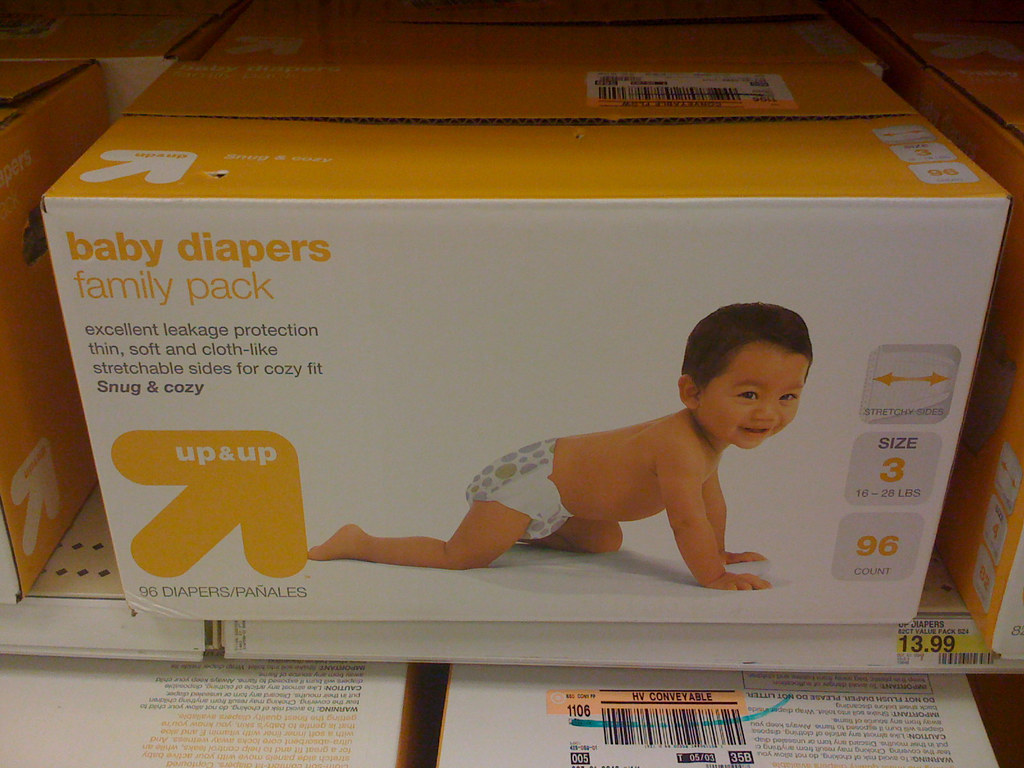
A consistent pattern in parenting forums: someone asks “are Up & Up / Parent’s Choice / Kirkland diapers actually any good, or do you get what you pay for?” The answers split predictably into “I tried them, they leaked, I switched back” and “I’ve used them for years and they’re fine.” Both groups are telling the truth about their own experience, which makes the answer for any new parent genuinely confusing.
This post tries to be useful about it. Specifically: what’s structurally different between a “store brand” diaper and a “name brand” diaper, where those differences matter, and how to evaluate which to try.
What “store brand” actually means
Most store-brand diapers in the U.S. aren’t made by the store. They’re made by a small number of large diaper manufacturers who produce private-label products alongside their branded lines.
Specifically (this changes occasionally as contracts shift):
– **Target’s Up & Up diapers** are manufactured by Kimberly-Clark, the same company that makes Huggies. They’re not the same product (Kimberly-Clark uses different specs for Up & Up), but they come out of the same general manufacturing infrastructure.
– **Walmart’s Parent’s Choice diapers** are manufactured by First Quality Enterprises, a large contract manufacturer that also makes premium private-label diapers for several other retailers.
– **Costco’s Kirkland Signature diapers** are manufactured by Kimberly-Clark (similar to Up & Up). The Kirkland line is positioned more premium than Up & Up.
– **Amazon’s brand (Mama Bear) diapers** are manufactured by First Quality Enterprises.
What this means in practice: store brands are *not* unbranded factory seconds or cheap knockoffs. They’re products made by established diaper companies, to spec, for the retailer. The materials and engineering are the same kind of materials and engineering that go into Huggies and Pampers.
The trade-offs are real, but they’re trade-offs the retailer is making deliberately to hit a price point.
Where store brands are typically equivalent
**Core absorbency.** The fluff pulp and superabsorbent polymer (SAP) in store-brand diapers is the same material category as name-brand diapers. The amount of SAP per diaper is typically a touch lower in store brands (a few grams), which translates to slightly less total fluid capacity, but not dramatically less. For an average daytime change, the difference is rarely noticed.
**Core safety features.** Wetness indicators, leg cuffs, stretch waistbands — these standard features are present in most store-brand premium lines. Sometimes one feature is omitted (some store brands skip the wetness indicator on larger sizes), but the core design pattern is the same.
**Materials safety.** Store brands generally use the same hypoallergenic, chlorine-free, fragrance-free materials as name brands. The major manufacturers have shared safety standards across their lines. A few store brands have additional certifications (Honest Diapers, which is technically a small-brand competitor rather than a store brand, has third-party hypoallergenic testing).
Where store brands typically differ
**Topsheet softness.** The non-woven layer that sits against your baby’s skin is one of the easier cost-saving areas. Store-brand topsheets are functional but typically a noticeable degree less plush than premium name brands. For most babies this is purely a comfort difference; for babies with sensitive skin it can matter more.
**Cuff engineering.** The leg cuffs that prevent leaks involve sub-engineering decisions: the height of the cuff, the strength of the elastic, the way the elastic threads through the leg opening. Store brands tend to use simpler cuff designs — adequate for normal use but more likely to leak under stress (a heavy overnight pee, a high-activity baby running around). Name brands have invested more in cuff design and it shows.
**Fit consistency.** Name-brand diapers have been refined across millions of babies and many product iterations. Store brands have fewer iterations and tighter design constraints. The result: store-brand fit is “fine on average” but more variable. The same Size 3 Parent’s Choice might fit one baby’s chunky thighs perfectly and another baby’s lean torso uncomfortably; name brands tend to fit a wider range of body types because they’ve been optimized harder.
**Stretch tabs and reusability.** This is a less obvious difference. Name-brand diapers tend to have re-fastenable tabs that hold up to multiple position adjustments. Store-brand tabs are often single-use — once unfastened, they’re harder to re-stick if you need to reposition. For parents who reseat the diaper after a wiggly change, this matters.
**Print and aesthetics.** Store brands typically have minimal print (a small logo, maybe a simple pattern). Name brands often have full-color prints with characters or designs. Aesthetic preference, not functional.
Where you’ll feel the difference, where you won’t
**Daytime use:** Most parents find store brands essentially equivalent to name brands for normal daytime changes. The leak rate is comparable; the comfort difference is minor; the cost savings are real.
**Overnight use:** This is where many parents feel the gap. Overnight diapers need to hold 10-12 hours of urine output without leaking, and the cuff and absorbency differences in store brands show up here. Most experienced parents recommend a premium overnight diaper (Pampers Swaddlers Overnights, Huggies OverNites) regardless of what they use during the day. Store-brand overnight options exist but the gap is wider.
**Outings:** A leak during a daytime change is annoying; a leak during a 3-hour outing is a disaster. Some parents stick with name brands when out and use store brands at home for cost savings. This is a sensible compromise if your store-brand experience has been mixed.
**Sensitive skin:** Babies with eczema, diaper rash, or skin reactions tend to do better on name brands or specialty brands (Honest, Hello Bello, Mama Bear’s premium line). Store-brand topsheets and chemical handling are *generally* safe, but if your baby is reactive, the marginal cost of switching to a specialty brand is worth it.
## Per-diaper cost reality
Store brands typically cost 25-40% less per diaper than equivalent name brands. The savings is real and meaningful.
For a baby using ~6 diapers/day for the first year (about 2,200 diapers across the year), the cost difference works out to roughly:
– $50-100/year on the smallest savings
– $150-250/year on the typical savings
– $300+/year if you switch comprehensively to bulk store-brand purchasing
That’s substantial money for many families. It’s also not life-changing money. The “should I switch?” question depends on your specific budget pressure and how much you value the marginal benefits of name brands.
How to evaluate store brands for your baby
A few suggestions:
**Start with a small pack.** Don’t buy a giant box of an unfamiliar brand without trying it. Store brands are sold in small “trial” sizes specifically for this reason. Spend a few dollars to test before committing.
**Use them in low-stakes situations first.** Daytime, at home, when you’re nearby for changes. Don’t try a new brand on a road trip or overnight; you’re setting up the brand to fail.
**Watch for fit issues, not just leak issues.** A store brand that leaks might be poorly designed or might just be wrong-sized for your baby. If it’s leaking around the legs, that’s a fit problem; try the next size up first before declaring the brand “doesn’t work.” If it’s leaking through the back or front (where the diaper itself is failing), that’s a brand problem.
**Compare specific use cases.** Daytime and overnight are different problems. A store brand that’s fine daytime might be wrong overnight. Buy one of each and test each in its own use case.
**Don’t trust your first impression.** Some store brands have updated their formulations meaningfully in the past few years (Up & Up redesigned in 2024; Parent’s Choice updated in 2023). A brand that failed you in 2022 might be different now.
The honest summary
Store-brand diapers from major retailers are usually adequate for daytime use, often produce real savings (typically $150-250/year), and have a small but real reliability gap compared to name brands — most noticeable in overnight use, high-activity periods, and for babies with sensitive skin. The decision is genuinely about how much your budget can absorb and how much your specific baby tolerates.
The pattern we see most often: parents use a name brand for the newborn months (when leaks would be especially disruptive), switch to a store brand for daytime once their baby is established, and keep a premium overnight diaper for sleep. That’s the cost-effective middle path. If your situation is different, the right answer might be different.
Browse all the brands in our search tab to compare current prices side-by-side.