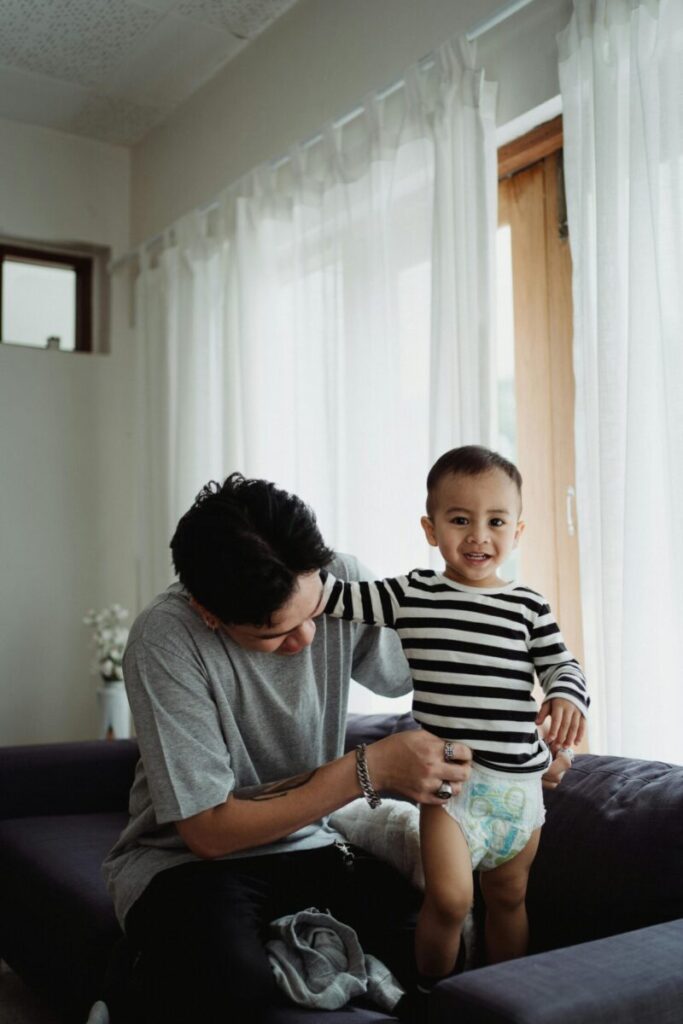
Most American parents start with tape-style diapers and don’t think much about it. The traditional rectangular diaper with adhesive tabs is the default — it’s what hospitals use, it’s what newborn-product gift bags are stocked with, it’s what every brand puts in their entry-level lines. Pants-style diapers (also called pull-ups, though that’s specifically a Kimberly-Clark brand name) come into the conversation later, usually around the time a baby starts crawling or standing.
The “when to switch?” question gets asked a lot, and the honest answer is: it depends on what’s happening with your baby. Here’s the structural comparison and the practical decision framework.
What’s actually different
**Tape-style (traditional)** diapers are rectangles. You lay the baby on top, fold the front up between their legs, and fasten with the two adhesive tabs on the sides. The tabs let you precisely control the snugness around the waist. You can re-fasten and re-position freely.
**Pants-style** diapers are pre-formed tubes. You pull them up the baby’s legs like underwear. There are no tabs. The waistband is elastic all the way around. To remove a soiled pants-style diaper, you tear it at the side seams (which are perforated for this purpose) rather than unfastening it.
The materials, absorbent core, and basic engineering are otherwise similar. Both come in the same sizes, both have comparable absorbency, both have similar safety features. The difference is purely in how the diaper is put on and taken off.
When tape-style is the right choice
**Newborn through early infancy (0-6 months).** Tape-style diapers are easier to fit precisely on a small baby. The tab adjustment lets you snug the diaper to fit a 7-pound newborn’s tiny waist, then loosen the tabs as they grow. Pants-style diapers in newborn sizes exist but tend to be loose or tight rather than perfectly adjustable.
**Heavy or messy changes.** A blowout is much easier to manage with tape-style: you unfasten the tabs, fold the diaper down without disturbing the mess, slide it out, clean up, fresh diaper underneath. Pants-style requires tearing the sides (which can spread mess) or rolling the diaper down the legs.
**Frequent fit adjustments.** Some babies, especially in the first few months, are between sizes. Their weight is in the overlap zone between two stated ranges, or their thigh-to-waist proportions are unusual. Tape-style lets you adjust per-diaper. If one diaper is fitting too tight or too loose, you can reposition the tabs.
**Sleep changes.** If you change diapers without fully waking the baby (which most overnight parents try to do), tape-style is faster and quieter. Pulling pants up sleeping legs takes effort.
**Cost.** Tape-style is typically cheaper per diaper than pants-style at the same brand and size. The cost difference is small (a few cents per diaper) but real.
When pants-style is the right choice
**Active babies (crawling, standing, walking).** This is the canonical switch point, and the most common reason parents convert. A wiggling baby on a changing table doesn’t want to lie still for tape adjustments. Pants-style lets you change a baby standing up — they hold onto a couch or your leg, you pull the old one off down the legs, pull a fresh one up the legs, done. The change takes seconds.
**Potty training.** Pants-style is the bridge product between diapers and underwear. The mechanical motion (pull up, pull down) is exactly what the toddler will be doing with underwear, so practicing the motion in a forgiving diaper is part of training. Many training-pants products (Pampers Easy Ups, Huggies Pull-Ups, Honest Training Pants) are pants-style specifically because they want to teach this motion.
**Mid-day changes for daycare or out and about.** A daycare provider changing 4-6 babies in a row appreciates pants-style speed. So does a parent in an airport bathroom with no changing table — pulling a pants-style diaper up a baby standing on your shoes is easier than tape-style on a public floor.
**Babies who fuss at tape-fastening.** A subset of babies seem to hate the moment of tabs being unfastened or the sound of tabs being re-fastened. Switching to pants-style eliminates that step. Counterintuitive but real.
**Older toddlers who refuse changes.** A 22-month-old who’s discovered “no” can make tape-style changes a wrestling match. Pants-style lets you change them while they’re standing, often distracted by something else, in less time than the protest takes.
What the manufacturers don’t say
Two things worth knowing that aren’t on any package:
**Pants-style diapers tend to leak slightly more than tape-style at the same size.** This is design-related: the all-around elastic waistband can’t be adjusted, so it’s either snug enough to seal or loose enough to leak. Tape-style lets you adjust the seal per-fit. The difference is small (maybe a 1-2% higher leak rate at scale) and most parents don’t notice in practice. Where they notice is overnight, when a pants-style diaper holding many hours of urine can develop a small leak at the leg cuffs that a precisely-fitted tape diaper wouldn’t.
**Pants-style “newborn” sizes exist but most parents skip them.** Some brands sell pants-style in size 3 (16-28 lb) or smaller, marketing them for newborns. In practice, most parents don’t switch to pants until at least size 4 (22-37 lb), when crawling and pulling-to-stand become regular. Earlier-size pants-style diapers exist mainly for travel use cases where the speed of changes matters more than fit precision.
## Specific products to consider
The major tape-style lines are well-established: Pampers Swaddlers, Pampers Cruisers, Huggies Little Snugglers, Huggies Little Movers. (Both Pampers and Huggies switch from their “newborn” line to their “active baby” line around size 3-4, with similar overall design.)
The major pants-style lines:
– **Pampers Cruisers 360°** — pants-style version of Cruisers, sized 3-7
– **Huggies Little Movers Slip-On** — pants-style version of Little Movers
– **Pampers Easy Ups** — training pants version, sized 2T-3T through 4T-5T
– **Huggies Pull-Ups** — the original training pants brand, sized 2T-3T through 4T-5T (also a learning-day-and-night version)
– **Honest Training Pants** — same use case, slightly more premium positioning
Most parents follow this rough progression:
1. **Birth to ~6 months**: Pampers Swaddlers or Huggies Little Snugglers, tape-style
2. **~6 months to ~14 months**: Pampers Cruisers or Huggies Little Movers, tape-style (more active fit)
3. **~14 months to ~22 months**: Pampers Cruisers 360° or Huggies Slip-On, pants-style (active toddler)
4. **~22 months to ~36 months**: Pampers Easy Ups or Huggies Pull-Ups, training pants (potty training)
These ages are approximate. Some babies stand and walk early (start of step 3 at 10 months), some are crawling but still happy on the changing table (stay in step 2 longer). Watch the baby, not the calendar.
The hybrid approach
Many experienced parents use both. Tape-style for sleep (better fit, better overnight containment), pants-style during the day (faster changes for an active baby), training pants only when active potty-training (so the baby isn’t confused about what diapers are vs. what underwear are).
This is more expensive than picking one, but it lets you match the diaper to the situation. It’s also fine to pick one type and use it across all situations — the trade-offs we’ve described are real but small.
If you’re switching to pants-style for the first time, buy one small pack to test. The fit feels different (pants are more form-fitting around the waist) and your baby’s first reaction matters. Some babies love the change; some object. Either way, you’ll know fast.
For current pricing across both tape-style and pants-style options, use our search tab and filter by diaper type.