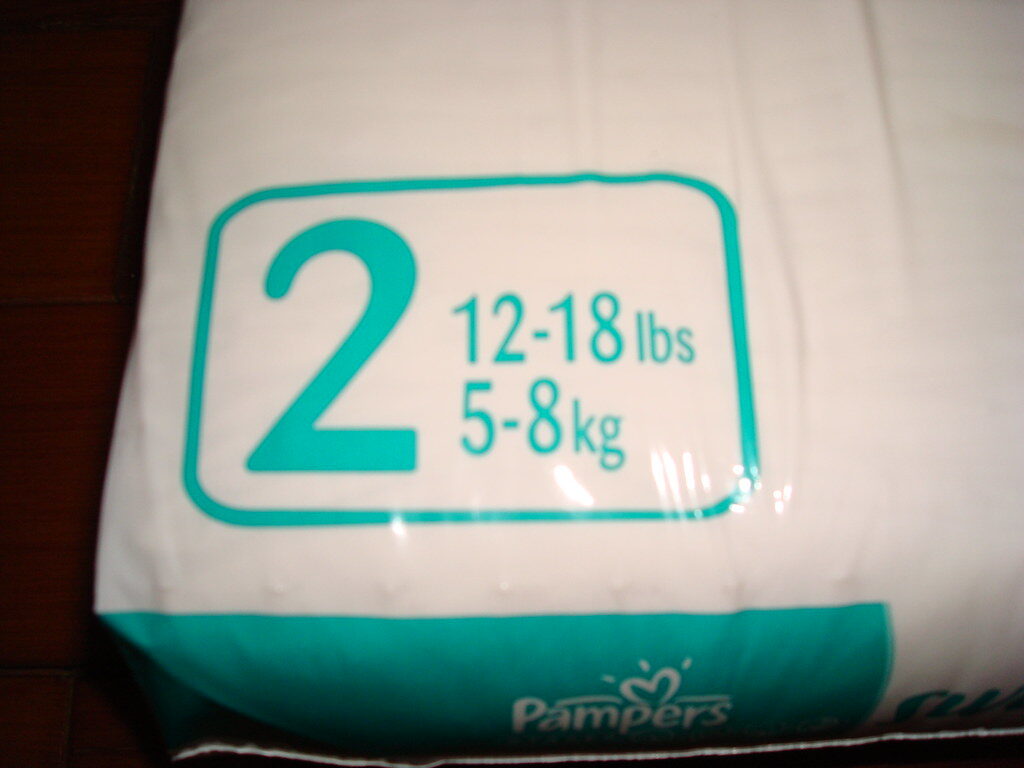
Every diaper package has a printed weight range on the front. “Size 3, fits 16-28 lb.” It looks authoritative, and we use it — every entry in our database is sourced from manufacturer-stated weight ranges. But that range is more of a marketing decision than a fit measurement, and parents who treat it as gospel end up frustrated. Here’s what’s actually behind those numbers and how we work around their limitations.
The 12-pound range problem
Look at any major brand’s size chart. The ranges are wide and they overlap.
Pampers Swaddlers Size 3: 16-28 lb. That’s a 12-pound range, covering roughly four to eight months of a baby’s growth.
Pampers Swaddlers Size 4: 22-37 lb. A 15-pound range that overlaps with Size 3 by six pounds.
These aren’t fit windows; they’re permission slips. The manufacturer is telling you that *somewhere in this 12-pound range*, this product will work for some babies. They’re not saying every baby will fit through the whole range. They’re not saying the diaper is engineered for the middle of it. They’re saying you won’t get a complaint if you bought this size for a baby weighing anywhere in here.
In practice, most diapers fit best when the baby is in the middle 60% of the range. A baby right at the bottom of a size is fresh out of the size below it — the new diaper may sag, leak in the legs, or have leg gaps. A baby right at the top is about to grow out of it — the diaper may compress, ride up, or pop tabs.
The way to use a manufacturer range is to know where your baby sits in it. The way *not* to use it is to assume any weight inside the range produces the same fit. Manufacturers won’t tell you which is which.
Why the ranges look the way they do
Three factors push manufacturers toward wide, overlapping ranges:
**Returns and complaints.** A narrow range invites returns when babies don’t fit perfectly. A wide range with overlap to the next size lets the company tell unhappy parents “try the next size up” without admitting their first purchase was wrong.
**Inventory simplification.** Wider ranges mean fewer SKUs. If Pampers had to make Size 2.5 and Size 3.5, retail shelf space would explode. By covering broad ranges with five or six sizes, they keep their inventory manageable.
**Marketing parity.** Every major brand uses roughly the same numeric sizes (Newborn through 6 or 7). If one brand offered “Size 3A” and “Size 3B,” they’d be admitting their sizing is more precise — and inviting competitors to call them complicated. Everyone sticks with the broad numeric system because it’s what parents expect.
None of these factors are about getting the diaper to fit better. They’re about commerce.
Where the ranges diverge between brands
Here’s where it gets concretely confusing. Compare published Size 3 ranges across brands:
– Pampers Swaddlers Size 3: 16-28 lb
– Huggies Little Snugglers Size 3: 16-28 lb
– Honest Diapers Size 3: 16-28 lb
– Hello Bello Size 3: 16-28 lb
– Up & Up Size 3: 16-28 lb
Same range, every brand. But the actual cut, leg cuff design, waistband elasticity, and rise height differ noticeably. Two babies of identical weight can have completely different experiences in two “Size 3” diapers because the products were designed against different body assumptions.
This is also why “what size?” is the wrong question to ask online. “Which Size 3 fits a long, lean baby with sensitive legs?” is a much better question — and one that depends on which babies the editorial team has actually tested. We don’t pretend to have an answer to the better question for every body type; we surface the products that fit the stated range and let parents try.
What we do with manufacturer ranges
We trust the ranges as a *lower bound* on the fit problem, not an answer to it.
We trust them to tell us:
– A given size is intended for *somewhere in* the printed range
– Going outside that range is more likely to produce a poor fit
– The next-size-up is what the manufacturer would point you toward when you’re outgrowing the current one
We don’t trust them to tell us:
– Whether your specific baby will be comfortable across the whole printed range
– Which brand’s Size 3 is the best Size 3 for your baby
– Whether you should size up when your baby is at the top of the range (you usually should, but the manufacturer won’t say so)
We work around the limitations by ranking products within a weight range, by surfacing adjacent sizes for weights near the boundaries, and by giving parents pricing information so they can experiment with a smaller pack of an unfamiliar brand without committing to a huge box.
How parents can read between the lines
A few practical tips for using manufacturer size charts well:
**Note the lowest weight in the range.** If a manufacturer says “fits 16-28 lb,” they’re telling you the diaper starts working at 16 lb. Below that, leg gaps and leaks are more likely. A 15-pound baby in a Size 3 diaper isn’t going to be comfortable, even though the difference looks small on paper.
**Don’t take the upper weight literally.** Manufacturer upper weights often reflect what the diaper *can* contain, not what fits comfortably. A 27-pound baby in a Size 3 isn’t going to leak, but the diaper may pinch at the legs or feel restrictive. Size up before reaching the top of a range.
**Watch for the next-size-up overlap.** When two adjacent sizes overlap by 4-6 pounds (very common), the overlap is the manufacturer’s way of telling you “you can use either size in this window.” It’s a transition zone. Either is fine; try whichever you have.
**Notice if a brand has unusually narrow ranges.** A few specialty brands publish narrower ranges (10-pound rather than 15-pound) — those brands are typically more precise about fit but also more expensive. Trade-off you can decide on.
The bigger point
Manufacturer size charts are the best public data we have, so we use them. But they’re written for shelf-marketing more than for fit. The actual diapering decision — “is this diaper working for my baby right now?” — is one only a parent can answer, and only after using the diaper. The size chart’s job is to narrow the field to plausible candidates. Our job is to make narrowing the field as easy as we can.
If you’ve found a Size 3 that runs noticeably small or large compared to the rest, please email us at contact@diaperfitfinder.com. We track those reports and add notes to product entries when we see consistent feedback.