For most of the 21st century, the conventional wisdom was that store-brand diapers were a budget compromise — cheaper but worse. You bought them when money was tight, accepted the leaks and rashes, and switched back to Pampers when payday came around.
That hasn’t been true for at least a decade. Several store brands now match or exceed name-brand performance, often manufactured by the same parent companies. The challenge is that the gap between the good store brands and the bad store brands is now wider than the gap between any store brand and Pampers.
This is our honest tier list of every major US store-brand diaper. Tested, ranked, no sponsorship — same as everything else on this site.
How we evaluated
We looked at five things, in order of importance:
- Absorbency — does it hold up to typical 3-4 hour daytime wear without saturating?
- Leak protection — does urine stay contained when the baby moves, sleeps, or is held at angles?
- Skin compatibility — fragrance, dye, and material composition relative to sensitive-skin brands
- Fit consistency — does the diaper fit similarly across babies of the same weight, with reliable tab adhesion?
- Per-diaper cost — actual landed cost including any required memberships, shipping, and minimum purchase quantities
We weighted absorbency and leak protection most heavily because these are what affect parents’ lives daily. A cheap diaper that leaks isn’t actually cheap.
S-Tier: Genuinely competitive with Pampers and Huggies
Kirkland Signature (Costco)
The store brand that proved store brands could win. Independently tested at or near the level of Pampers Swaddlers across all major performance metrics. Sold only at Costco — requires a $65/year Gold Star membership ($130/year Executive).
What works:
- Absorbency on par with name brands. We’ve tested side-by-side; the difference, if any, is within the noise of normal product variation.
- Soft top sheet that’s noticeably better than the cheaper store brands.
- Wetness indicator and umbilical cord cutout in newborn sizes — the small features that show the manufacturer was actually thinking about parents.
- Pricing is roughly 30-40% below Pampers Swaddlers per diaper, larger pack sizes available.
The catches:
- Costco membership is required. For a heavy diapering household (a year of size 3+), the savings cover the membership cost in 2-3 months. If you’re not already a Costco member for other reasons, do the math first.
- Limited to Costco stores and Costco.com. Can’t grab a small pack on a regular grocery run.
- Not all sizes always in stock. Newborn especially is hit-or-miss.
- Only available in Pampers Swaddlers-equivalent style (no Cruisers-equivalent for active toddlers), though the Swaddlers-style fit works for most babies through size 5.
Best for: any Costco member, full stop. If you have access to Costco, Kirkland Signature is the default starting point.
Member’s Mark (Sam’s Club)
Sam’s Club’s house brand. Direct competitor to Kirkland Signature in the wholesale-club category. Performance is genuinely close — we’d call it functionally tied with Kirkland on absorbency and leak protection. Some parents prefer the fit, some prefer Kirkland; it varies by baby.
What works:
- Same value proposition as Kirkland: name-brand quality at significant discount.
- Sometimes available at lower per-diaper pricing than Kirkland, depending on Sam’s Club promotional pricing.
- Includes overnight version that competes well against Pampers Swaddlers Overnight.
The catches:
- Sam’s Club membership required ($50/year Club, $110/year Plus).
- Sam’s Club has fewer locations than Costco in many regions. Verify there’s a store within reasonable distance.
- Member’s Mark has, historically, had more inconsistent batch-to-batch quality than Kirkland Signature. Most batches are great; occasionally a pack feels noticeably less polished. We’ve tracked this for several years and it’s been better recently, but the reputation lingers in parent circles.
Best for: Sam’s Club members, parents in regions where Costco isn’t accessible.
Up & Up Sensitive (Target)
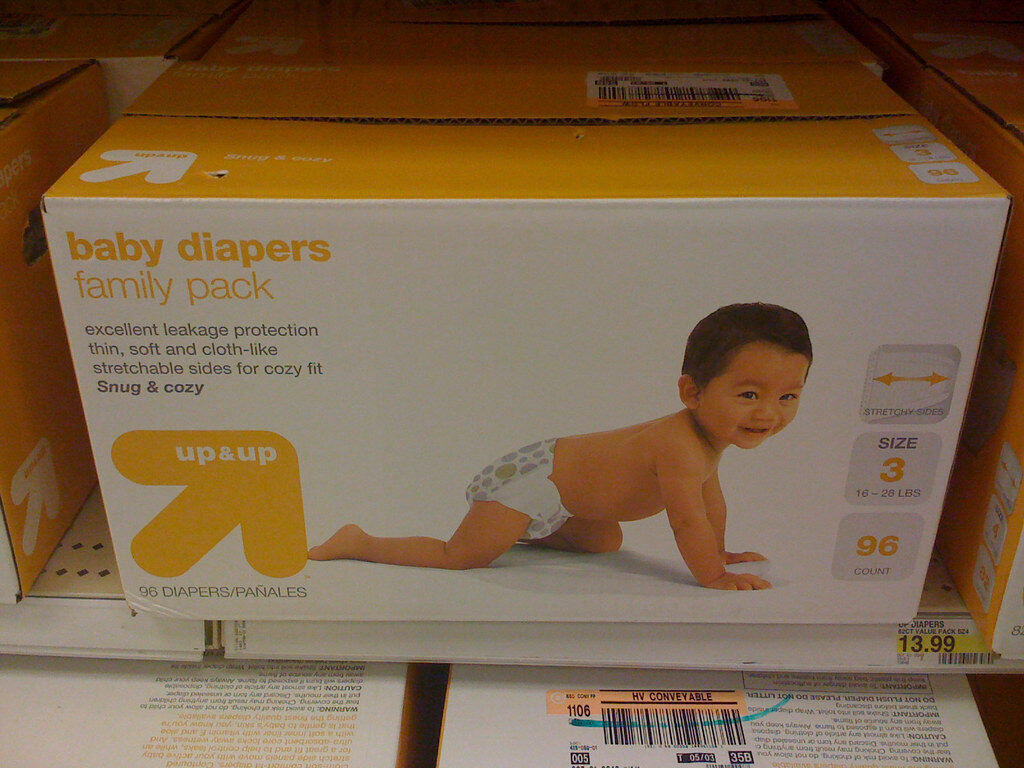
Target’s sensitive-skin store brand sits in S-tier. The standard Up & Up line is a B-tier product, but the Sensitive version is a different animal — fragrance-free, dye-free, with a softer top sheet that competes with Pampers Pure at meaningfully lower cost.
What works:
- Genuinely fragrance-free (some diapers labeled “fragrance-free” still have detectable scent; this one doesn’t).
- Soft top sheet, well-designed leg cuffs.
- Available at every Target — no membership required, easy to grab on a regular shopping trip.
- Subscribe & Save through Target’s circle program brings the price down further.
The catches:
- Only a daytime version; no Up & Up Sensitive overnight.
- Standard Up & Up (non-Sensitive) is a noticeably worse product at lower cost. Don’t confuse the two — the packaging looks similar.
Best for: parents who want sensitive-skin performance without paying Pampers Pure prices, and who prefer Target’s accessibility over wholesale clubs.
A-Tier: Solid value with minor compromises
Mama Bear (Amazon)
Amazon’s house brand. Performance has improved substantially in recent years; this used to be a B-tier product and is now a strong A-tier.
What works:
- Very competitive pricing, especially with Subscribe & Save’s 5-15% discount.
- Available in larger pack sizes than most retail store brands.
- Absorbency is solid for everyday daytime wear.
- Convenient if you already do most household shopping on Amazon.
The catches:
- Top sheet softness is noticeably below the S-tier brands — fine for a typical baby, but parents whose babies have any sensitivity should compare carefully.
- Fit is sometimes inconsistent batch-to-batch; the size 3 from one shipment may fit slightly differently from the size 3 in the next.
- Available only on Amazon.
Best for: Amazon households who want store-brand savings without leaving the platform.
Hello Bello (Walmart)
Founded by Kristen Bell and Dax Shepard. Available exclusively at Walmart and on hellobello.com. Positioned as Honest’s more affordable competitor.
What works:
- Fragrance-free, gel-free pulp, decent absorbency.
- Cute prints (Honest’s main aesthetic differentiator, replicated at lower price).
- Walmart pricing is genuinely competitive with Pampers Pure for similar feature set.
The catches:
- Not as soft as Coterie or as eco-certified as Bambo Nature; sits between premium and budget rather than at either pole.
- Walmart distribution means availability varies by store.
- Some parents report the leg cuffs are flimsier than name brands — slightly more prone to leaks at the legs when the diaper is fully saturated.
Best for: parents who want cleaner ingredients than baseline Pampers but don’t want premium pricing.
B-Tier: Acceptable budget options
Up & Up Standard (Target)
Target’s mainline house brand (not the Sensitive version). Performance is acceptable for the price, but you can do better at the same or lower cost with the Sensitive variant.
What works:
- Cheap. Often the cheapest reasonable diaper at a non-club retailer.
- Easy to grab.
- Fit is consistent.
The catches:
- Has fragrance, which is the most common cause of contact dermatitis.
- Top sheet is rougher than the higher-tier options.
- Absorbency is noticeably below name brands; parents often need to change more frequently.
Best for: truly budget-constrained parents who don’t have wholesale-club access. Otherwise, jump up to Up & Up Sensitive — the small price difference is worth it.
Parent’s Choice (Walmart)
Walmart’s house brand, the budget anchor of the category.
What works:
- The cheapest option at any major retailer that isn’t a wholesale club.
- Available everywhere Walmart is, no membership.
- Performance is genuinely acceptable for the price — it’ll keep your baby dry through a normal daytime change cycle.
The catches:
- Has fragrance and dyes.
- Top sheet is the roughest among major brands; some babies’ skin will react to extended wear.
- Tab adhesion has occasional batch issues — every parent who’s used Parent’s Choice for any length of time has had a tab come off mid-change.
- Limited information about ingredients and manufacturing.
Best for: parents on a tight budget without Costco or Sam’s Club access. Pair with frequent changes and a barrier cream.
Comforts (Kroger family stores)
Available at Kroger, Ralphs, Fred Meyer, King Soopers, and other Kroger-owned chains. Sometimes also at Fry’s and Smith’s depending on region.
What works:
- Convenient if you already grocery shop at Kroger.
- Pricing is competitive with Up & Up.
- Performance is similar to Up & Up Standard — acceptable but not impressive.
The catches:
- Limited regional availability.
- Less product range than other store brands; fewer specialty variants (no overnight, limited training-pants offerings).
- Performance varies meaningfully by Kroger sub-brand region.
Best for: Kroger shoppers who want a store brand on the regular grocery run.
C-Tier: Avoid unless you have no alternative
Berkley Jensen (BJ’s Wholesale)
BJ’s Wholesale’s house brand. The wholesale-club store brand that didn’t keep up with the others.
What works:
- Cheaper than name brands at BJ’s.
- Available in larger pack sizes.
The catches:
- Performance lags Kirkland and Member’s Mark by a noticeable margin. Absorbency is closer to a baseline retail store brand than to wholesale-club competitors.
- BJ’s membership required, which means you’re paying membership fees for an inferior store brand.
- Limited regional distribution (East Coast).
Best for: existing BJ’s members who can’t easily access Costco or Sam’s Club. If you have a choice, switch wholesale clubs.
“Bargain bin” no-name brands
You’ll occasionally see deeply-discounted no-name diapers at deep-discount retailers (Five Below, Dollar Tree, certain TJ Maxx clearance racks) or via random Amazon sellers. These are typically:
- Closeout or near-expiration inventory
- Off-brand manufacturing from overseas with no US distributor
- Sometimes counterfeit packaging
Avoid these. The savings are marginal, the quality is unpredictable, and you don’t have customer-service recourse if something goes wrong with your baby’s skin.
How much do you actually save?
For a child who uses 2,500 diapers a year (about 7 a day for the first 18 months), here’s roughly what you spend on diapers across a typical 30-month diapering window:
- Pampers Swaddlers at retail: $1,400-$1,700 over 30 months
- Pampers Pure at retail: $1,800-$2,200
- Coterie subscription: $2,400-$2,800
- Kirkland Signature (Costco): $850-$1,100 + $65/year membership = $1,012-$1,262 total
- Member’s Mark (Sam’s Club): $850-$1,100 + $50/year membership = $975-$1,225 total
- Up & Up Sensitive (Target): $1,150-$1,400
- Parent’s Choice (Walmart): $750-$950
The biggest savings come from wholesale-club store brands. But the “Pampers premium” — the difference between brand and competing store brand — is roughly $400-$650 over the full diapering window, not the thousands you’d assume from per-diaper pricing.
Whether that premium is worth paying depends on your household. Some parents pay it because they want the highest-confidence option; others save it and put the difference toward something else.
Should you switch?
If you’re currently using Pampers or Huggies and considering trying a store brand:
- Buy the smallest pack available of one S-tier or A-tier option (Kirkland, Member’s Mark, Up & Up Sensitive, Mama Bear).
- Use it for one full week, not just one day. Some performance differences only show up after multiple days.
- Watch for: leaks, red marks at legs/waist, rash development, tab failures.
- If everything is fine after a week, switch and save the money. If something is meaningfully worse, switch back — the per-diaper savings aren’t worth a frustrating week.
Most babies don’t notice the difference between S-tier store brands and name brands. The minority who do are usually babies with skin sensitivities, and those parents should stay on a sensitive-skin line regardless of brand vs. store-brand status.
The store brand market shifts. We re-test these annually. If you’ve had a notably different experience with a brand listed here, tell us — we update this guide based on real reports.